A small folded program has a sequence as well as a surface. The front is seen first, two inside panels appear together when it opens, and the back can be read while it is closed. For an original comparison, imagine a fictional Willow Table Supper with four short information blocks. Two program plans use exactly the same blocks. The decision is which information should share the first open view, rather than which plan has more decoration.
Declare the object before arranging its words
This exercise assumes a single sheet folded once into a four-panel booklet, opened from right to left like an ordinary English-language book. The four reading positions are front, inside left, inside right and back. That is a reader-facing plan, not a printer-ready imposition file or a report that a physical proof has been folded.
The four complete blocks below are original fictional copy. They contain the same event, times and practical details in both versions. No real venue, meal service, route or accessibility arrangement has been verified. Their specificity lets us compare an actual reading task without pretending that a supper has taken place.
Welcome block: “Willow Table Supper. Saturday, 14 September. Welcome from 6:00 p.m.; supper begins at 6:30 p.m. Please keep this program for the evening.”
Running-order block: “6:00 Welcome. 6:30 Supper. 7:15 A short thank-you. 7:30 Conversation and coffee. 8:00 Evening ends.”
Table-information block: “For questions about tonight's food, speak with the host at the welcome table before taking a serving. Water is on the side table. Please keep the doorway clear.”
Departure block: “Please collect your coat from the welcome-table area before leaving. If you have arranged a pickup, meet your driver outside the main entrance. Thank you for sharing the evening.”
Version A gives the opened spread to the evening in progress
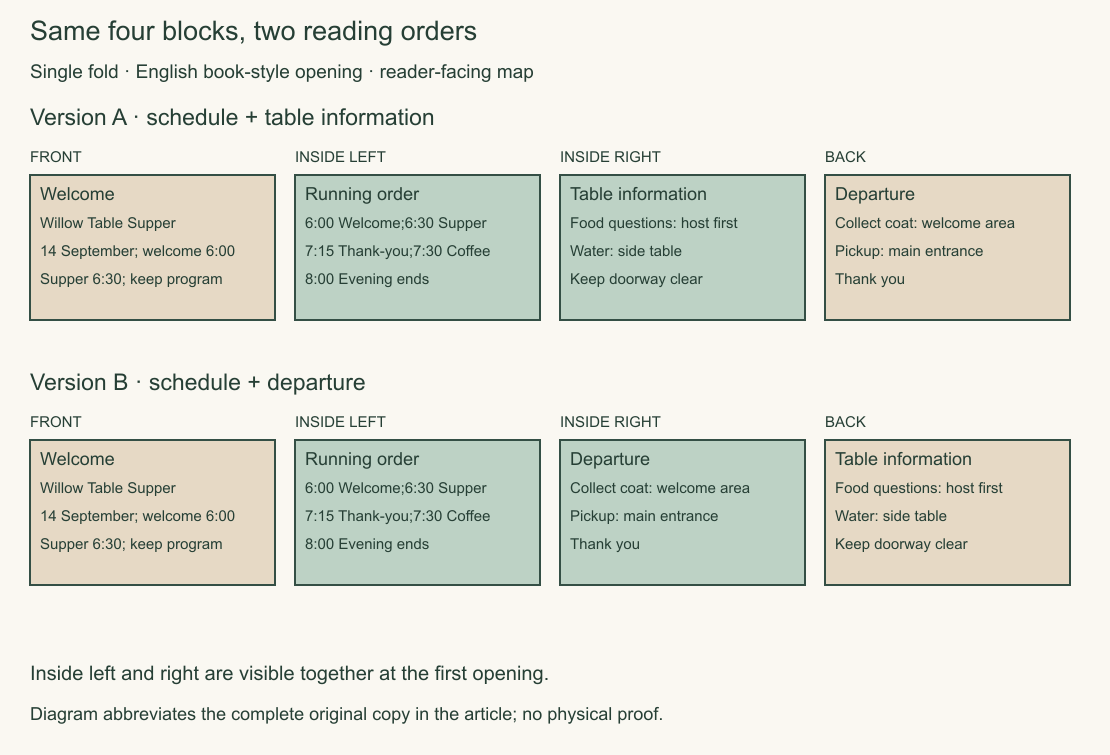
In Version A, the welcome block goes on the front. Opening the booklet reveals the running order on the inside left and table information on the inside right. The departure block sits on the back. All four blocks appear once, with no repeated copy added to make this version seem more complete.
The practical effect is a pairing: a reader who opens the program to check when supper starts also has food-question and doorway information in the same spread. Someone already at the table can keep that open view available during the meal. These are proposed uses of the layout, not observations of guests reading it.
The trade-off is that departure information is elsewhere. A reader holding the program open must turn it over or close and inspect the back to find that block. If departure arrangements were the central concern throughout a particular real event, this allocation might not serve the organizer's priority.
Version B pairs the running order with departure at the first opening
Version B keeps the same welcome front and running order inside left, but places departure on the inside right and table information on the back. The words have not changed. The first opening now pairs the schedule with the end-of-evening instructions; the food-question information requires a look at the back.
That plan could be chosen when readers need to consult departure details alongside the end time. Its cost in our fictional supper is separating the meal schedule from the instruction to speak with the host before taking a serving. A program cannot make every block equally immediate in every state simply by being small.
Compare the two plans with one concrete question: while the booklet is open at the running order, which second block is already visible? Version A answers table information; Version B answers departure. The useful difference is that relationship, not a claim that one arrangement is universally clearer or that guests will reliably follow either instruction.
Choose the pairing, then check the actual artifact
For this fictional supper, I would choose Version A because the meal and the food-question route are the immediate paired task. I would retain departure on the back rather than add a duplicate that changes the comparison. Another event could justify Version B, but the organizer should be able to name the task that makes the pairing useful.
The original diagram maps the four reading positions. It does not tell a printer how to place artwork on both sides of a production sheet. Before making a real program, check the actual folded proof, legibility, final copy and event facts. A digital four-box plan cannot establish how paper, type size or a printer's orientation will behave.
Keep headings descriptive so that Welcome, Running order, Table information and Departure describe their contents. The decision here is already complete without purchasing a template: choose what the first opening should put together, then confirm that the actual object preserves that intended order.
Sources & further reading
Published sources for the details and examples discussed in this story.