A card reading Cedar tells a guest which table to find. A card placed at a particular chair tells them something more. The difference becomes clearer when the guest list stays fixed. These two original plans use eight fictional people at two tables with four intended places each. They compare the information being assigned, rather than claiming that either arrangement guarantees conversation or suits every guest's access needs.
Keep the people and groups unchanged
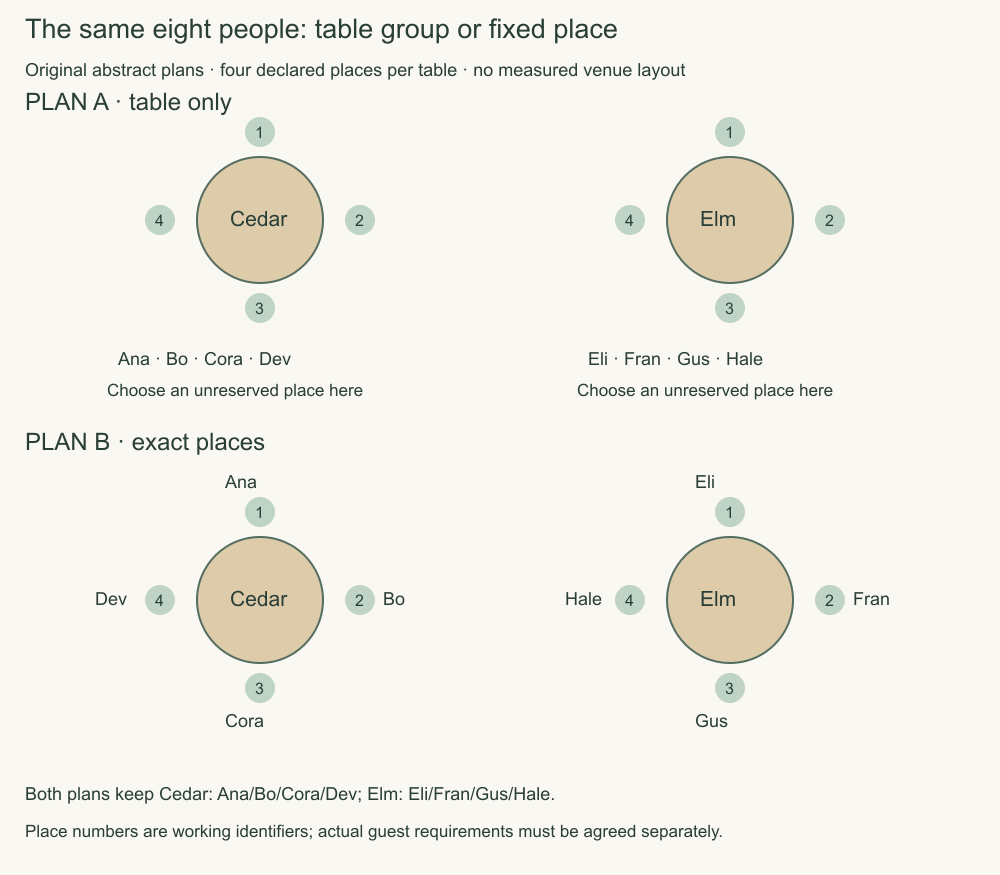
The fictional guest list is Ana, Bo, Cora, Dev, Eli, Fran, Gus and Hale. Cedar is the table for Ana, Bo, Cora and Dev. Elm is the table for Eli, Fran, Gus and Hale. Both plans retain those exact groups, so a change in social mix cannot explain their difference.
Each table has four declared places, labeled 1 through4 on the private working sketch. These are abstract locations, not measured furniture positions, clearance dimensions or a venue layout. Actual guest requirements and actual room arrangements need discussion before a real host decides what can be offered.
Emily Post's textual advice accompanying Where to Sit at the Table distinguishes finding a place card, following a host's direction and asking where to sit if direction has not been offered. That supports making the instruction legible. The two plans and the names below are original examples, not plans supplied or approved by the Institute.
Plan A assigns the table and leaves the place open
The arrival list says Ana—Cedar, Bo—Cedar, Cora—Cedar, Dev—Cedar; Eli—Elm, Fran—Elm, Gus—Elm, Hale—Elm. There are no individual name cards at the eight places. The host's complete direction is: “Your table is shown beside your name. Within that table, choose an unreserved place; please ask me if anything about the arrangement needs changing.”
The phrase within that table matters. It does not invite a guest to switch groups, move furniture or take any place in the room. In the example, the host has made no promise that Ana will sit beside Bo or face a particular part of the room. A guest who needs a particular arrangement must not be expected to secure it by arriving first.
Before using this plan, the real host would need to resolve actual seating requirements and communicate any reserved places clearly. If one position must be kept available by agreement, it cannot remain visually indistinguishable from every open place. A table-only plan may need a limited reservation rather than a sweeping claim that every place is freely interchangeable.
Plan B assigns all eight places
The second plan uses the same groups but specifies Cedar1 Ana, Cedar2 Bo, Cedar3 Cora, Cedar4 Dev; Elm1 Eli, Elm2 Fran, Elm3 Gus, Elm4 Hale. Each actual place in this fictional plan carries its named card. The arrival list still identifies the table, and the table card makes Cedar or Elm visible.
The host's direction now reads: “Your table is shown beside your name, and your name card marks your place at that table. Please ask me if the arrangement needs changing.” This supplies a particular location while preserving a route to raise a problem. A printed card does not make an unsuitable place suitable.
A change needs attention at both levels. If Ana and Cora agree a different arrangement with the host, revise the relevant place information rather than leave competing versions on the arrival list and table. Do not infer a guest's needs from an empty chair or silently label a move as a preference they expressed.
Choose which information the gathering actually needs
Plan A leaves a choice within a defined group; Plan B communicates a selected place as well. Neither has added a ninth capacity or changed the four-person groups. The useful question is whether particular positions need to be arranged, and what guests have actually agreed with the host.
Start with readable table identification and a clear explanation, using an ordinary working list before ordering elaborate stationery. A beautiful name card cannot resolve an unconfirmed arrangement. Once the real choices are settled, give guests the information corresponding to the plan actually in use.
Sources & further reading
Published sources for the details and examples discussed in this story.