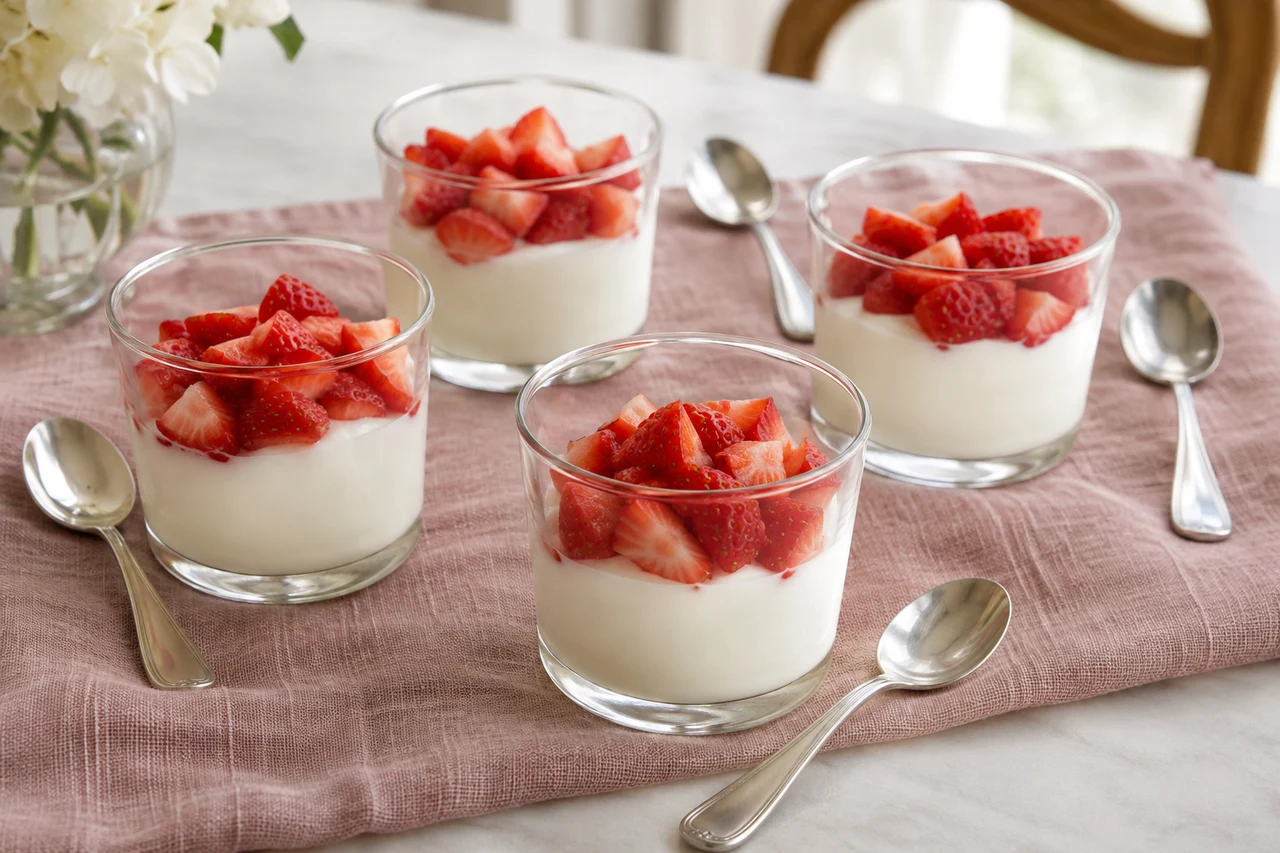
A small spooned dessert can have a clear serving plan without a separate sauce, crumble and garnish. This original proposal uses only plain yogurt and strawberries, divided between four suitable cups. Its quantities and arrangements are untested editorial suggestions, not a dessert we prepared, tasted or served to guests. Ask about the actual diners' requirements and check ingredient labels before treating the simple list as suitable for everyone.
Set out the complete four-cup quantity
Use 400 grams plain commercially prepared pasteurized dairy yogurt and 200 grams strawberries after washing, trimming and removing unsuitable parts. That allocates 100 grams yogurt and 50 grams prepared fruit to each of four cups. No sweetener, biscuit, nuts, cream or decorative leaves are included. Choose cups that comfortably hold a portion and allow a spoon to reach it; this recipe supplies no claim about a particular vessel's capacity.
Use the actual yogurt's label and refrigeration instructions. Dairy yogurt contains milk, so the dish is not an allergen-free or dairy-free menu. Another product would need its own ingredient and handling review rather than an automatic substitution based on its package color. If a guest cannot use these ingredients, choose a genuinely appropriate alternative instead of assuming the short list settles their requirements.
Prepare the fruit and the serving space
Begin with clean hands, cups, spoons, a clean knife and board. Wash the strawberries under running water before trimming; FDA advises against washing produce with soap. Keep the preparation away from utensils and surfaces used for raw meat, poultry or seafood. Remove the leafy tops and cut the usable berries into small pieces before weighing the prepared 200-gram amount.
Keep the yogurt refrigerated while organizing the cups and fruit. Four ordinary small dishes may work as well as matching dessert glasses if they suit the portions and utensils. The purpose of arranging them first is to make the next task clear, not to imply that this preparation has been rehearsed or that a special serving set is necessary.
Choose one of two complete arrangements
For the first proposal, spoon 100 grams yogurt into each cup and place 50 grams prepared strawberries on top. Repeat for all four. The fruit remains a distinct top layer. These quantities are ingredient allocations, not a measured final yield or a tasting verdict about the balance.
For the second proposal, begin each cup with 50 grams yogurt, add 25 grams strawberries, then repeat with another 50 grams yogurt and 25 grams strawberries. The totals stay at 100 grams yogurt and 50 grams fruit per cup. Only the distribution changes. This offers two fruit layers within the same small ingredient list; no claim is made about how long the layers will remain separate or how a particular yogurt will hold its shape.
Finish near the serving moment
Assemble close to serving and serve promptly. If waiting, cover the cups suitably and keep refrigerated at or below 40°F/4°C, following the yogurt label as well. FDA's prompt-chilling boundary for perishables is two hours, shortened to one hour above 90°F. That is not a reason to leave dessert out until the boundary, and this untested proposal supplies no new shelf life for assembled cups.
Before adding a topping assortment to the shopping basket, decide whether it serves this particular four-person plan. The fruit-on-top version requires one distribution; the repeated-layer version gives the same ingredients another arrangement. If you later try either, record your own serving preference and any quantities you actually change. A successful guest response, tested sweetness level or completed dinner party is not claimed here.
Sources & further reading
Published sources for the details and examples discussed in this story.