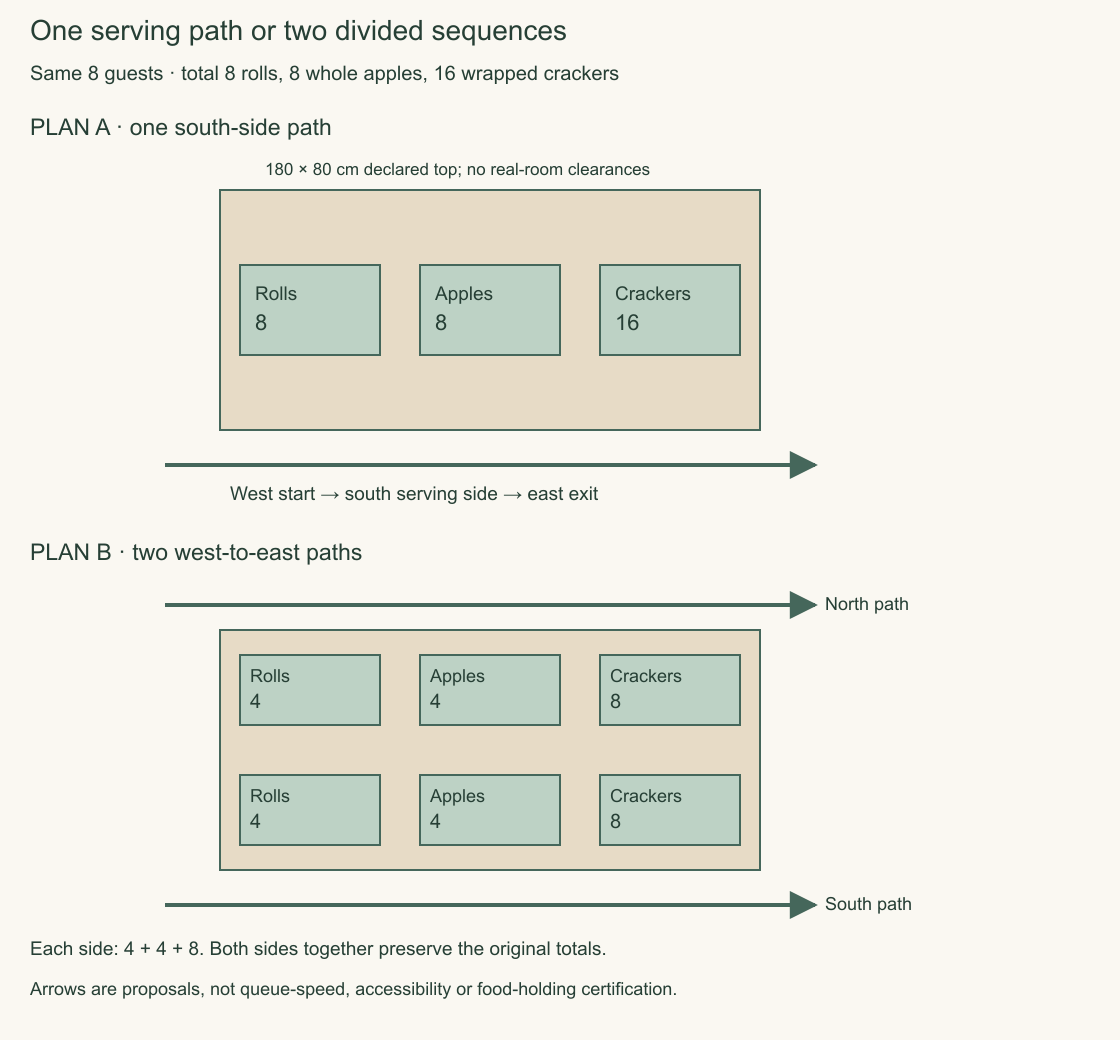
Adding a second approach to a serving table does not require doubling the food, but it does require deciding where the second path begins, what it reaches and where it ends. Two original plans use the same fictional eight-person refreshment gathering and the same quantities:8 bread rolls,8 whole apples and 16 individually wrapped crackers. The diagrams compare access to those items, not measured queue times or a complete meal allowance.
| Fixed fictional quantity | Plan A: one side | Plan B: each of two sides |
|---|---|---|
| Bread rolls:8 | 8 inone station | 4 each side |
| Whole apples:8 | 8 inone station | 4 each side |
| Wrapped crackers:16 | 16 inone station | 8 each side |
| Proposed direction | South side, west to east | Both sides, west to east |
| Unresolved real condition | Room, guests and handling | Room, guests, demand split and handling |
Fix the menu and the table model
The imagined table top is 180 centimeters long, west to east, and 80 centimeters deep, north to south. Those dimensions define the drawing, not a tested piece of furniture. No guest has walked around it, and no minimum aisle or accessibility clearance is inferred from the space outside its outline.
The three food groups remain the same in both plans. Whole apples are washed appropriately before serving; packaged items remain subject to their actual labels and handling requirements. The counts are declared design inputs, not a nutritional plan or a claim that each guest will choose exactly one roll, one apple and two crackers.
This deliberately simple menu lets the path question remain visible without introducing a hot dish, refrigeration equipment or a recipe that the diagram cannot explain. If a real gathering uses a different menu, its actual preparation, holding and service requirements must be resolved separately. A bowl drawn on a table is not evidence that a food can remain there indefinitely.
Plan A gives the group one side and one order
In Plan A, the serving path runs along the south side from west to east. The three stations appear in that order: all 8 rolls, all 8 apples, then all 16 wrapped crackers. The proposed arrival point is at the western end, and the proposed exit from the serving path is at the eastern end. The north side is not shown as a second guest-serving route.
That arrangement gives one repeated sequence to explain. A guest approaching at the declared start encounters rolls before apples and crackers. It also puts the full quantity of each group at one station. The drawing cannot tell us how long a guest takes to choose, whether someone skips a station or how people behave when they reach the end.
For an original planning discussion, the host might say, “Please start at this end and continue along the serving side.” That is a proposed instruction, not proof that a queue forms correctly or that the real room supports it. If the actual entry or exit conflicts with another activity, the table plan needs to change.
Plan B duplicates the sequence by dividing the quantities
Plan B offers a path on each long side, both moving west to east. Each side has its own rolls, apples and crackers stations in the same order. The north-side sequence contains 4 rolls,4 apples and 8 wrapped crackers; the south-side sequence contains the remaining 4,4 and 8. Adding the halves gives the original 8,8 and 16.
Two groups can therefore approach different sides in the drawing without reaching toward one central bowl from opposite directions. That is a geometric feature of the declared plan, not evidence of faster service. One side might attract more guests than the other, or one group might choose more of an item. Equal starting quantities do not establish equal demand.
The host also has two sets of stations to observe and maintain. If one side runs short, any actual redistribution must preserve appropriate handling and the intended arrangement. Do not quietly change the original comparison into twice the food or a larger guest count to make the second path look more generous.
Inspect the meeting points, not only the arrows
Both paths in Plan B reach the eastern end. The room must provide an appropriate next destination rather than simply combining people at a new bottleneck. The diagram supplies no doorway, seating plan or usable clearance beyond the table. Those require the real room and the people who will use it.
Likewise, two arrows do not certify access for someone who needs a particular reach, turning space or form of assistance. Discuss actual requirements with the relevant guests and venue. If the setting cannot accommodate the proposed paths, one clearly understood arrangement may serve the gathering better than a second line drawn for appearance.
I would compare the plans by asking what each person can reach from the intended side and where they go next. Plan A has one sequence with the full quantities. Plan B has two repeated sequences with split quantities and a shared downstream question. Neither is automatically the better choice for an unspecified room.
Keep food-handling constraints outside the path shortcut
FoodSafety.gov advises washing produce under running water and using clean hands, utensils and surfaces. Its guidance also addresses safe cooking, holding and prompt refrigeration of perishable foods. Those requirements do not become optional because the service path looks orderly. Follow the actual food and equipment instructions for a real menu.
For this original refreshment plan, retain the whole-fruit and packaged-item identities rather than substituting an unexamined prepared dish. If a real item needs refrigeration or another controlled condition, resolve it before using the layout. No holding temperature, equipment capability or food-safety compliance has been tested by these drawings.
Before buying more serving pieces, check whether the second set has an appropriate role and a real place. The useful design decision is one path with full stations or two paths with divided stations, followed by a check of the actual room, food and guests. More arrows and more bowls are not substitutes for that check.
Sources & further reading
Published sources for the details and examples discussed in this story.