The house in Emily Dickinson’s I dwell in Possibility does not remain an ordinary house for long. Its openings multiply, its roof reaches the sky, and its final activity belongs to a pair of hands. Reading all twelve lines of the Academy’s identified 1929 transcription, I follow that changing scale. This is an original literary interpretation, rather than a creativity exercise, a description of Dickinson’s home or a promise about personal growth.
A comparison establishes the dwelling
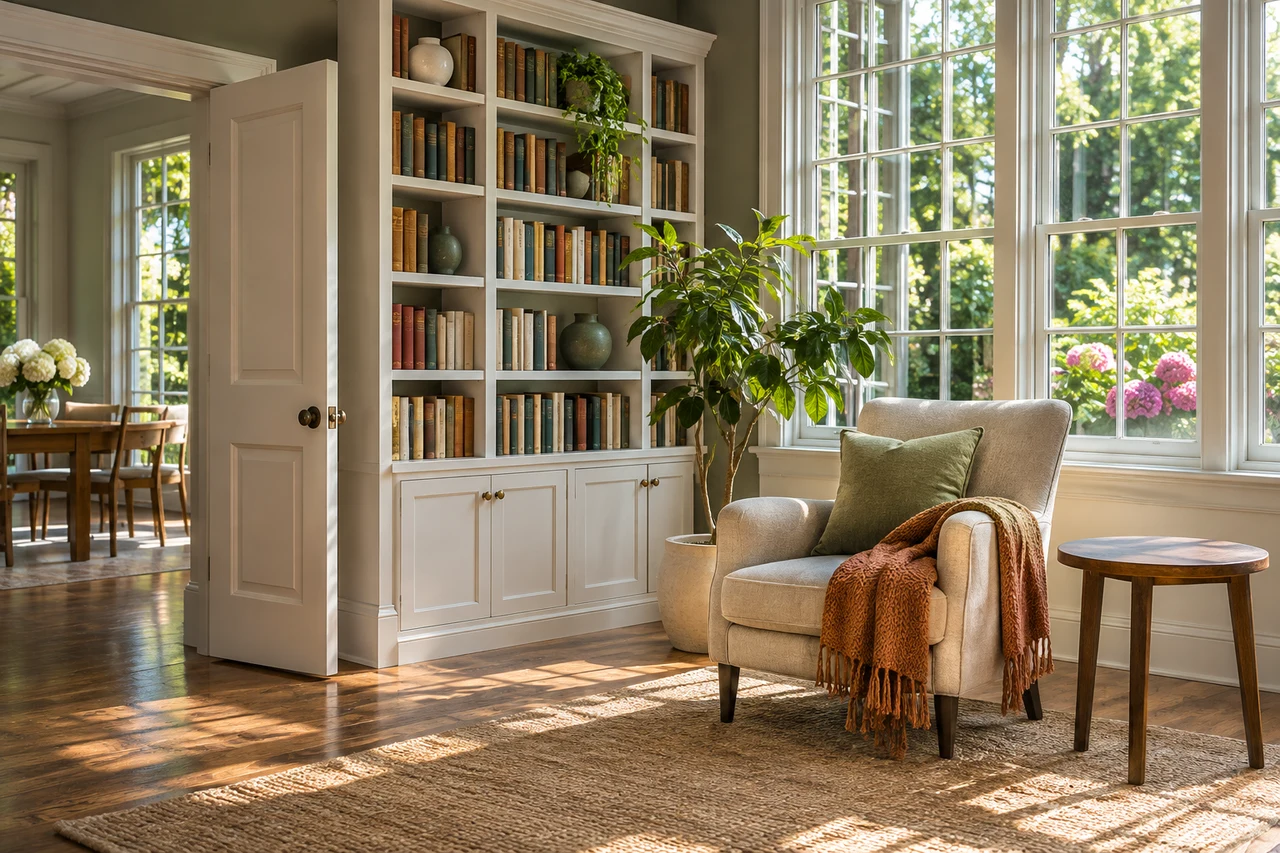
The opening names Possibility as a place to inhabit, then compares its house with Prose. Windows and doors make the preference architectural rather than leaving it as an abstract announcement. I hear the building’s openings doing part of the argument: they offer ways of looking and passing through.
A reading note can ask why the voice uses a dwelling at all. A house can suggest a place one occupies repeatedly, rather than a momentary glimpse. That is my interpretation of the image, not a factual statement about how the author worked or what every reader should do to become more inventive.
The chambers and roof exceed the first scale
The next stanza introduces chambers through cedars and gives the roof a relation to the sky. The language preserves recognizable house terms while making the imagined structure difficult to draw as a practical floor plan. I find that mismatch productive: the building can be named without being contained by a conventional outline.
The resistance to an eye also complicates a simple story about openness. More windows do not mean every interior is automatically available to inspection. I would keep that limit alongside the expansive roof rather than summarize the poem as an uncomplicated instruction to let everything in.
Visitors lead toward an occupation
The final stanza begins with visitors, then turns to what the dwelling’s occupant does. The movement changes the question from what the house contains to what activity belongs there. That makes the ending more particular than a statement that the imagined building is beautiful.
The hands are described through a narrowness that their spreading gesture seems to exceed. In my reading, that contrast lets a limited bodily form reach toward an abundant object. It is a figure within the poem, not evidence that an actual person has achieved an unlimited creative capacity or a religious conclusion the article can verify.
Return from the gesture to the first doorway
After the final gathering, I want to reread the initial house. Its openings now lead toward an occupation, not simply a superior property. That retrospective connection is the reason to retain the complete poem rather than borrow its first line as a motivational heading.
The Academy names the 1929 collection and editors and identifies this text as public domain. This article follows that witness; it does not reproduce a manuscript, portrait or modern editorial commentary. A useful reading edition keeps its source clear and allows comparison without pretending that different punctuation has no history. The free text already supports a conversation about dwelling, access, scale and gesture. A purchase should contribute something you actually want to read, rather than promise the life a quotation appears to advertise.
Sources & further reading
Published sources for the details and examples discussed in this story.