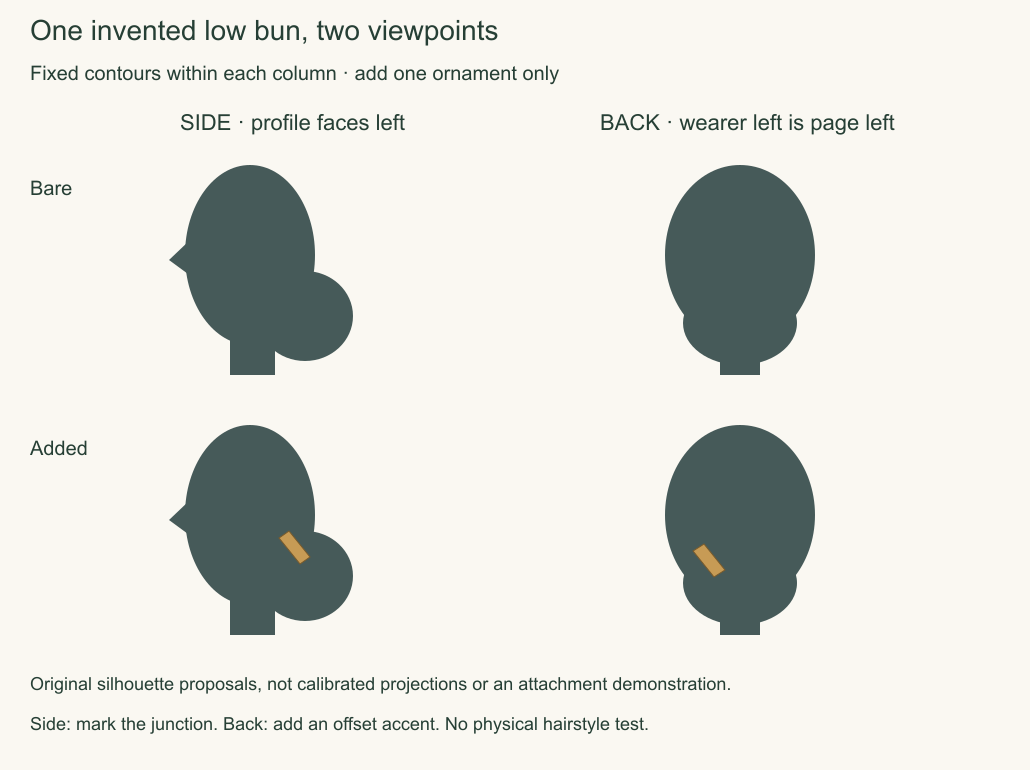
An ornament that reads as a small accent in a side view can occupy a more conspicuous place in a back view. To make that relationship visible, these original drawings use one invented low-bun silhouette and a single plain decorative shape. Each viewpoint has a bare version and a version with the ornament. The comparison concerns the drawing's outline and emphasis, not whether a real accessory can be fastened securely or reproduce this proposed appearance.
Hold the hairstyle fixed within each viewpoint
The side study shows a profile facing page left, with the bun extending behind the head on page right. The back study looks toward the back of the head, so the wearer's left is page left. The bun sits low and centrally in that back drawing. These declarations keep a change of viewpoint from silently becoming a change in hairstyle.
Within each column, the bare and ornament versions use identical head, hair and bun outlines. Only the single ornament is added. Comparing a looser bun on one row with a tighter bun on another would make it harder to tell what the added object contributes. The fixed contours give the visual question a bounded answer.
The drawings are authored silhouette studies, not calibrated projections of a three-dimensional model. They do not supply head measurements, hair density, product dimensions or evidence that a stylist has made this arrangement on a person.
Read the side view as a junction
In the side proposal, the ornament appears near the upper junction between the bun and the rest of the hair. It adds a short contrasting shape at the place where two larger outlines meet. The rearward extent of the bun remains unchanged; adding the ornament does not make the bun itself larger in the comparison.
I would describe its role here as marking the junction. That is more precise than saying it makes the hairstyle elegant or suits every profile. A viewer could prefer the uninterrupted bare contour. The drawing gives that preference something particular to address rather than requiring agreement with a general style adjective.
No clip, comb teeth, pin path or fastening pressure is represented. The visible decorative shape is not evidence of an attachment method. An actual product would need its own appropriate instructions and a real discussion with the person doing the hair.
Read the back view as an offset accent
The back proposal places the same imagined accent at the upper-left edge of the bun in this declared view. Because the bun is centered, the accent becomes an offset point against a broadly balanced silhouette. It does not move the bun or introduce a second ornament to make the back seem more finished.
That is a different relationship from the side junction even though both drawings refer to one proposed accessory. Looking only at the profile could miss how conspicuous the offset becomes from behind. Looking only at the back could miss its small role where the bun meets the head in profile.
The useful comparison is therefore two questions: do I want the junction marked in the side study, and do I want the offset accent in the back study? They concern the declared design. They do not establish how the object would look when someone moves, how much hair would cover it or how a photograph's lighting would affect it.
Take the visual preference into a real discussion
For an actual appointment, bring the relevant views and explain the relationship you prefer rather than asking someone to guarantee an identical silhouette. Ask the responsible professional about the real hair, accessory and intended use. Do not choose a product merely because a drawn shape has the same color.
My preference in this invented comparison is the ornament version when I want both the marked side junction and the offset back emphasis. If I wanted an uninterrupted outline, I would keep the bare version. The complete result is that stated preference across two views, not a purchase recommendation or an unperformed fastening trial.
Sources & further reading
Published sources for the details and examples discussed in this story.