Moving around a sculpture can change what overlaps and what remains visible. That does not necessarily mean the sculpture moved. A mobile introduces another possibility: separate parts can change their positions within the work itself. Those two changes deserve different looking questions. MoMA's record for Alexander Calder's Lobster Trap and Fish Tail, dated Roxbury, Connecticut, 1939, offers a documented starting point. The record includes Mobile and Kinetic art categories. It is not a promise of something to see on a forthcoming trip: the page read for this article says not on view.
Start with the record, then change the question
The museum identifies the medium as painted steel wire and sheet aluminum and the object number as 590.1939.a–d. Those details anchor the named work; they do not demonstrate a particular movement sequence. MoMA defines a mobile as a sculpture of balanced, separate parts that move, especially in response to air currents.
That definition adds an axis of comparison to the ordinary act of changing one's viewpoint. The observer may move, the object's parts may move, or both may change during an encounter. A useful looking question keeps those possibilities separate instead of calling every altered silhouette motion.
For a prospective museum visit, this changes the question carried into the gallery. Alongside “What becomes visible from another position?” ask “Is a change happening between the parts themselves?” This is a general looking prompt, not an instruction to locate or operate the Calder work.
First case: the observer changes position
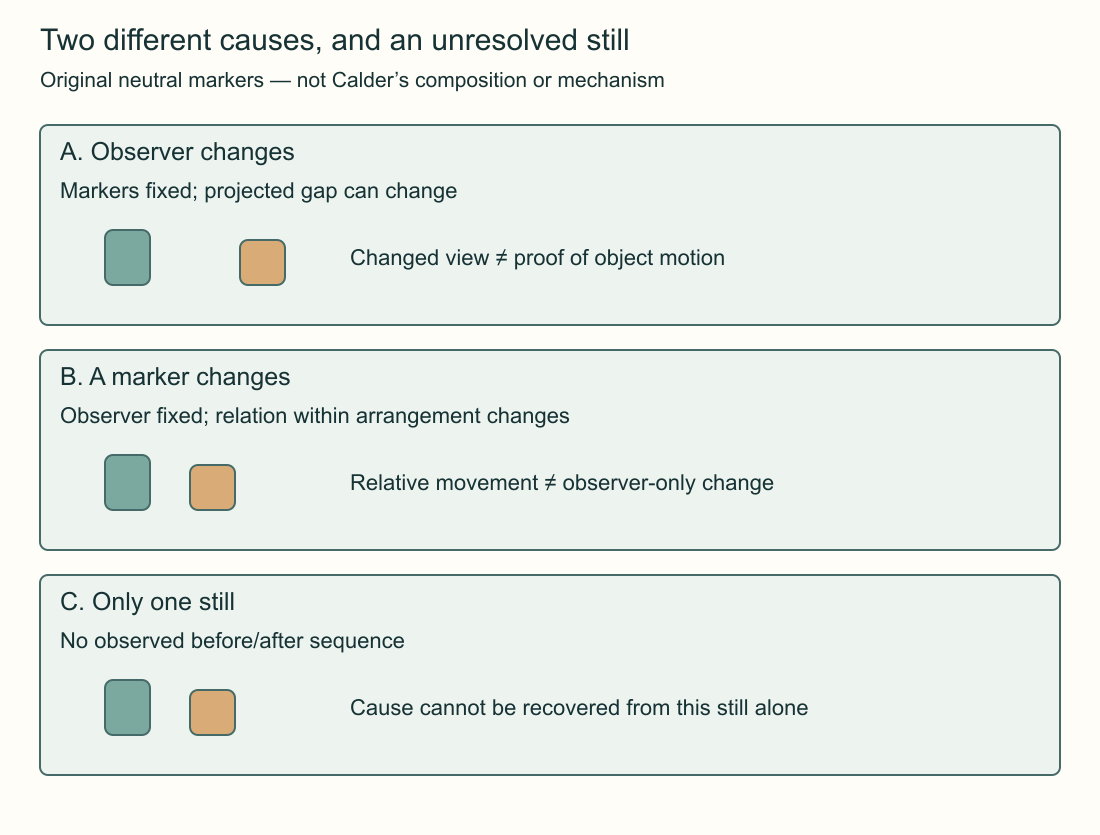
Imagine an original neutral arrangement with two plain rectangular markers at different depths. They remain fixed. From one position, a visible gap separates them; from another, their projected outlines partly overlap. The observer has changed the view, while the markers keep the same relationship in the imagined space.
Calling that difference a changed view is informative. Calling it proof that the two markers moved would add a claim the example does not support. A photograph from each position can make the altered outline easy to compare while leaving the underlying cause dependent on what is known about the setup.
This is the familiar reward of looking from more than one permitted position: an object need not move for a new relationship to become visible. Keep that observation available when considering a mobile, rather than abandoning it just because the museum uses a movement-related category.
Second case: a part changes relative to another part
Now hold the imagined observer's position fixed. Keep marker A fixed as well, but move marker B within the arrangement. The gap changes because the arrangement itself has changed. This is a different cause from the first case, even if the two resulting flat pictures happen to look similar.
The original diagram uses generic markers to separate those causes. It does not reconstruct Calder's composition, show his mechanism or predict a path followed by a part of Lobster Trap and Fish Tail. Its labels identify the controlled conditions in the invented example: observer changes in one row; a marker changes in another.
In a museum encounter where viewing is permitted, relative positions provide a useful question: does a part change against another part while your viewpoint stays reasonably steady? An apparent shift caused by walking should not automatically answer yes. Nor does a quiet interval establish that the documented category is wrong.
Third case: one still image leaves the cause open
A single still can show a recorded arrangement. On its own, it cannot display the passage from one arrangement to the next. A title, a museum category and a visible gap are different kinds of information; putting them together should not silently create an observed sequence.
Consider an invented note saying only, “The rectangles overlap here.” It records a visible relationship in the schematic, but it does not tell whether the observer moved, a rectangle moved, both moved or neither moved before the image. A stronger note names what was actually observed over time and what remained fixed.
That distinction matters when preparing for a trip with online records. You can learn the museum's classification before going without claiming to have watched the work move. If no appropriate observation is possible, a question can remain unanswered. There is no need to invent a direction, speed, motor or source of airflow.
Carry a looking prompt rather than a promised encounter
A compact personal prompt might read: “For a work described as a mobile, distinguish my changed view from a change between its parts. Record only what I can actually observe; check the museum's current information before expecting a particular work.” The prompt remains useful even when the named starting example is not displayed.
MoMA's general kinetic-art description mentions motion produced by motors or responsiveness to air currents. That is a category explanation, not evidence that this particular work uses a motor, moves continuously or will move during a particular visit. The named record and the observed event still do different jobs.
Leave the museum object and its surroundings undisturbed. The exercise is about looking and describing evidence, not producing motion or requesting a demonstration. If the opportunity is only to read a record, the honest outcome can be a clearer question for another permitted encounter.
A visit note can then separate three lines: documented category, actual viewpoint conditions and observed change over time. Keeping those lines distinct makes room for both a useful museum fact and a careful personal observation without turning either into a story that did not happen.
Sources & further reading
Published sources for the details and examples discussed in this story.