
A traveler can hold two flight confirmations for what feels like one journey while the airline treats the bag as stopping between them. The flights may look neatly connected on a personal itinerary, but that layout is not the baggage arrangement. American Airlines' consumer FAQ makes a specific distinction: it will not through-check a bag on a separate reservation. Its stated condition requires all tickets in the same reservation and an onward American or oneworld flight. Here is an original two-reservation example that follows the bag rather than pretending to establish missed-connection protection. There are no live flights, fares or airport transfer times in the example. The useful result is a list of actual handoffs that must be resolved before two independent bookings can work with the traveler’s luggage.
Put the reservation boundary on the journey
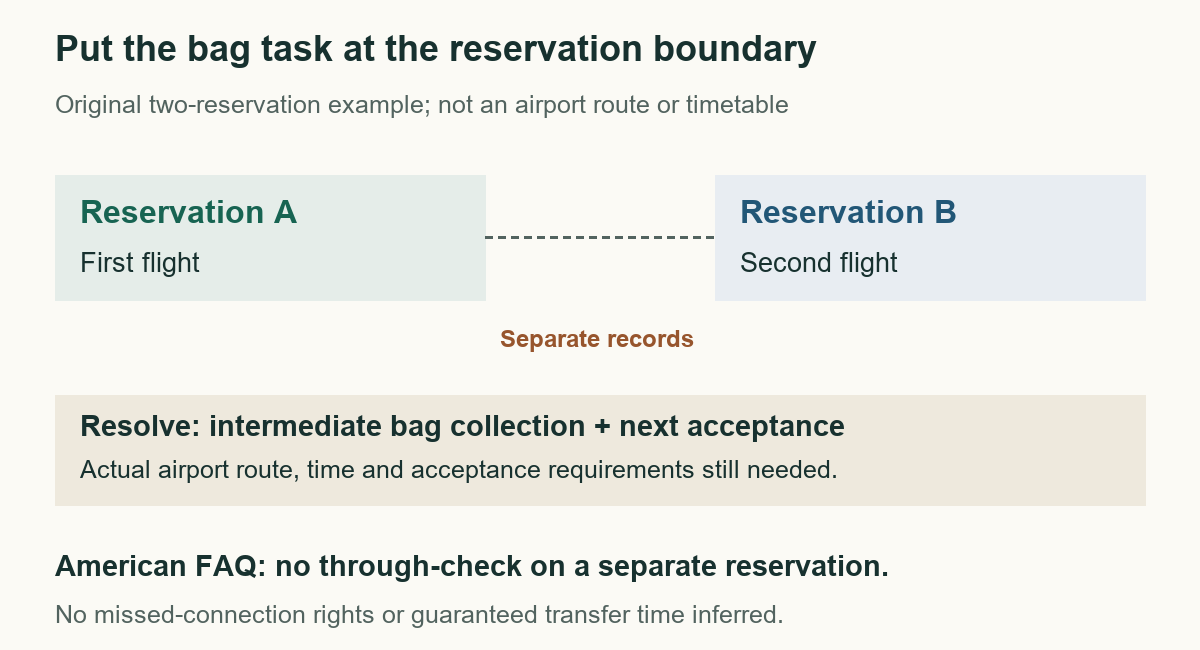
Imagine a traveler flying on American to an intermediate airport, then taking another American flight booked separately. Call the first reservation A and the second reservation B. The letters are fictional labels for two records; they do not describe airline booking codes or a ticketing system.
The traveler wants to check one suitcase at the beginning and collect it only after flight B. Under the FAQ's separate-reservation answer, that hoped-for through-check is not the arrangement to assume. Both aircraft having the same airline name does not supply the missing same-reservation condition.
Write the two reservations on separate lines, with the bag question beside the boundary between them. This is more informative than drawing one long arrow from home to final destination. That long arrow describes what the traveler hopes to accomplish, while the two records describe the bookings they actually hold.
A confirmation message sent to a traveling companion can preserve the same distinction: “Two reservations; need to resolve suitcase collection and a new bag handover at the intermediate stop.” That wording records a planning task. It does not claim a particular baggage belt, service desk or entitlement that nobody has checked.
Follow the suitcase before choosing the gap
For this invented plan, the suitcase needs an intermediate collection and another acceptance for the second journey rather than the requested through-check. Those are tasks to investigate at the actual airport. The fact that the traveler can walk from one arrival gate to another departure gate does not establish that the bag can follow that same route without another handover.
Work backward from the second booking's real acceptance requirements. Then establish the first flight's baggage collection arrangements, the route between collection and the second handover, and any other applicable airport procedures. A connection on a personal calendar is not evidence about the duration of these tasks.
Consider two possible outcomes after those enquiries. One arrangement leaves a workable interval under the actual flight and airport conditions. Another requires changing one flight or reconsidering the checked bag. The original choice is between those complete arrangements, not between two attractive departure times considered without luggage.
No universal spare-hour recommendation can finish that comparison. An interval generous at one airport may not answer the route, operating hours or bag-acceptance limit at another. If the actual information is incomplete, keep the bag plan unresolved before spending money on a non-changeable booking. The uncertainty belongs in the travel decision rather than being hidden by a reassuring arrow.
A new handover is a new part of the plan
At the beginning of the trip, read the destination shown on the actual bag record and resolve any mismatch with the airline. Do not interpret a suitcase disappearing onto a belt as proof that it has been accepted through to the destination you wrote in a notes app. The physical handover and the destination recorded for it need to agree.
At the intermediate airport in our example, the traveler must still carry out the collection and subsequent acceptance arrangements that were established. The second confirmation alone does not perform those actions. Keep the relevant identifying records accessible so a bag question can be related to the actual flight and suitcase.
In the invented stop, follow three physical states of the same suitcase: it was handed over for A, it is collected at the intermediate point, and it is accepted for B. The traveler still has one bag, even though there are two acceptance events. A note saying only 'bag checked' loses which of those events has actually happened. Attach the event to the relevant booking before treating the next stage as complete.
Keep baggage scope separate from disruption rights
The FAQ answer used here concerns through-checking. It does not decide what happens if the first flight is delayed, whether the second airline must rebook the traveler or whether an agency can alter the booking structure. Those questions require their own applicable terms and actual records.
Likewise, the answer's same-reservation condition should not be inflated into a promise that every possible bag on such a booking will be handled identically. Our example tests the condition that is plainly missing from two separate reservations. It does not invent exceptions, airport-specific procedures or an assurance about unusual baggage.
Before committing to the proposed trip, put the resolved bag handoffs alongside the passenger itinerary and review both bookings' actual conditions. If the result is too fragile for the traveler’s needs, changing the plan is a concrete outcome. It is better to discover that before committing to a journey whose handling sequence has never been established.
Sources & further reading
Published sources for the details and examples discussed in this story.